NYCEDC’s M-CORE Program Aims to Incentivize Commercial Office Building Renovations
Client memorandum | July 10, 2023
Authors: Tal Golomb, Melissa Brown
In an effort to decrease vacancies and attract world-class tenant companies to Midtown and Lower Manhattan, the New York City Economic Development Corporation (NYCEDC) has introduced the Manhattan Commercial Revitalization Program (M-CORE), which will be administered by the New York City Industrial Development Agency (NYCIDA). M-CORE is intended to incentivize transformative renovations of aging commercial office buildings by offering the following benefits to building owners: (i) property tax stabilization and abatement for a period of up to 20 years, (ii) exemption from City and State sales and use taxes for eligible construction materials and services, and (iii) partial exemption from City and State mortgage recording tax (MRT).
M-CORE is a competitive, discretionary program and the pre-application period for the first round of the first tier of M-CORE benefits runs until August 1, 2023. NYCEDC has announced that M-CORE’s benefits will be capped at 10M gross square feet of eligible commercial office projects City-wide.
Eligibility & Selection Criteria
To be eligible, a building owner’s proposed renovation project (Project) must be for a single commercial office building that is at least 250,000 gross square feet in size that was built before the year 2000 and located in Manhattan below 59th Street (excluding buildings located within the Hudson Yards Financing Area, the Penn Station General Project Plan Area and on Governors Island). Eligible Projects must include substantial capital investments of not less than 75% of the most recent New York City Department of Finance assessed value of the land and the existing building (the Minimum Investment Threshold). Projects that have already begun construction are not eligible, nor will the NYCIDA consider residential buildings or buildings located outside of the specified geographical area.[1]
The NYCIDA will prioritize applicants with Projects that (i) have near-term targets for construction commencement and completion, (ii) can reasonably secure the necessary funding or financing, (iii) position the building to attract high-growth industry tenants (such as tenants from the tech, non-lab life science, cybersecurity, green economy, media, entertainment (including gaming), IT and engineering sectors), (iv) include landlord programming and amenities that will encourage occupants to return to the office, (v) activate the building’s ground floor with uses intended to attract foot traffic to the applicable commercial corridor, (vi) involve buildings with high vacancy rates, (vii) demonstrate a plan to comply with New York City local law 97 with respect to reducing carbon emissions, and (viii) have a plan to utilize at least 30% Minority/Women-owned Business Enterprises (MWBE) during Project construction.
M-CORE Benefits
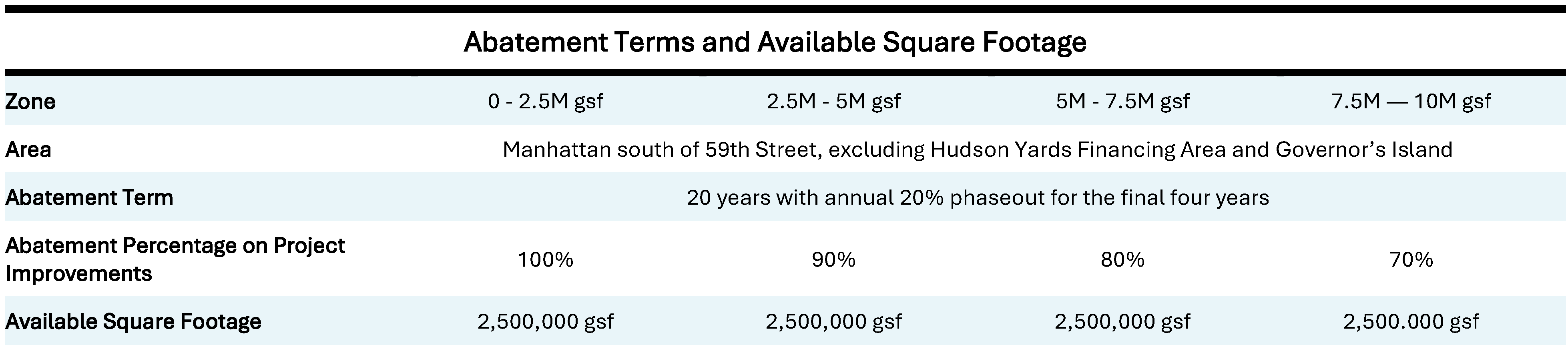
The stabilization and abatement benefits will be offered in four descending tiers of 2.5M gross square feet, with each tier offering stabilization of real property taxes on the land and existing building at the rate and assessment level applicable at the closing of the NYCIDA transaction and abatement of real property taxes on the Project improvements over a period of up to 20 years (the Abatement Period), with an annual 20% phase out of the benefits over the final four years of the Abatement Period. Although stabilization will remain constant across all tiers, the abatement offered in the first tier will be 100%, and each successive tier will decrease by 10% as shown in the chart below.
Although the Minimum Investment Threshold for M-CORE is substantially higher than that of the existing Industrial and Commercial Abatement Programs (ICAP), M-CORE’s benefits are somewhat more generous than those offered under the ICAP programs. As compared to ICAP, M-CORE offers a longer Abatement Period, stabilization of the property tax rate and assessment at 100% of the pre-renovation value of the existing building and land, sales and use tax exemption, and partial MRT exemption. See below for a chart comparing M-CORE’s benefits with those of ICAP:

Timeline & Process
Upon the closing of the first round of pre-applications on August 1, 2023, NYCIDA staff will review the pre-applications and notify the selected applicants in September 2023. Detailed information regarding the pre-application requirements can be found here. Selected applicants will work with NYCIDA staff directly to prepare NYCIDA’s Core Application, which requires the applicant to provide detailed information regarding (i) existing and proposed tenants of the building, (ii) sources and uses of Project funds, (iii) other buildings owned or leased by the applicant or its affiliates, (iv) environmental matters, (v) existing and proposed retail uses, and (vi) the applicant’s and its tenants’ employees. The applicant will also work with NYCIDA staff to prepare the inducement package, which includes, among other things, a signed term sheet with a financial institution to secure the necessary funding to complete the Project, a background investigation questionnaire, three years of financial statements for the applicant, affiliates and guarantor (if applicable), and an organizational chart. Beginning on November 8, 2023, the NYCIDA will present each Project to the NYCIDA’s Board of Directors (the Board) at its monthly meetings.
Once approved by the Board, the NYCIDA and the applicant will negotiate the project documents. Similar to other NYCEDC/NYCIDA programs, M-CORE project documents will include, among others, a lease of the property to the NYCIDA and a lease of the property back to the owner. Approved Projects will be subject to NYCEDC’s standard program requirements applicable to the property owner and/or building tenants, including compliance with the City’s living wage and prevailing wage, MWBE participation, labor peace agreements for certain retail and food service establishments, HireNYC participation, and reporting. Descriptions of and additional information regarding NYCEDC’s program requirements are included in the pre-application materials.
Prior to closing with the NYCIDA, the applicant must have an approved MWBE plan and provide an executed construction agreement and proof of all required insurance. Any financing will be expected to close simultaneously with the NYCIDA transaction. At the NYCIDA closing, the applicant will be required to pay various project fees, administrative fees and the legal fees of the NYCIDA’s outside counsel. The NYCIDA’s current fee schedule is included in the pre-application materials.
Conclusions
While we expect the NYCIDA to strictly apply the eligibility and selection criteria to the initial round of applications, we anticipate more flexibility in subsequent rounds. Potential applicants should consider reaching out to the NYCIDA with specific Project eligibility questions and, as always, we are available to assist in any way we can.
[1] The IDA has made the following clarifications regarding eligibility: (a) a commercial condominium unit in a building with both residential and commercial uses may be eligible, provided that the unit independently satisfies the other eligibility criteria (including the size requirement); (b) if a qualifying building is subject to a ground lease, then the ground lessee may be eligible to apply if the ground lessee currently pays the building’s real property taxes and is not already paying payments-in-lieu-of-taxes; and (c) funds earmarked for tenant improvements may count toward the Minimum Investment Threshold if the owner is the party expending the funds and contracting for the work.
This communication is for general information only. It is not intended, nor should it be relied upon, as legal advice. In some jurisdictions, this may be considered attorney advertising. Please refer to the firm’s data policy page for further information.