EU’s Twelfth Russian Sanctions: Intragroup services and non-Russia trade in line of fire
International Trade and Investment Alert™ | January 10, 2024
Authors: Dr. Tobias Caspary, Valeri Bozhikov and Romain Girard
Introduction
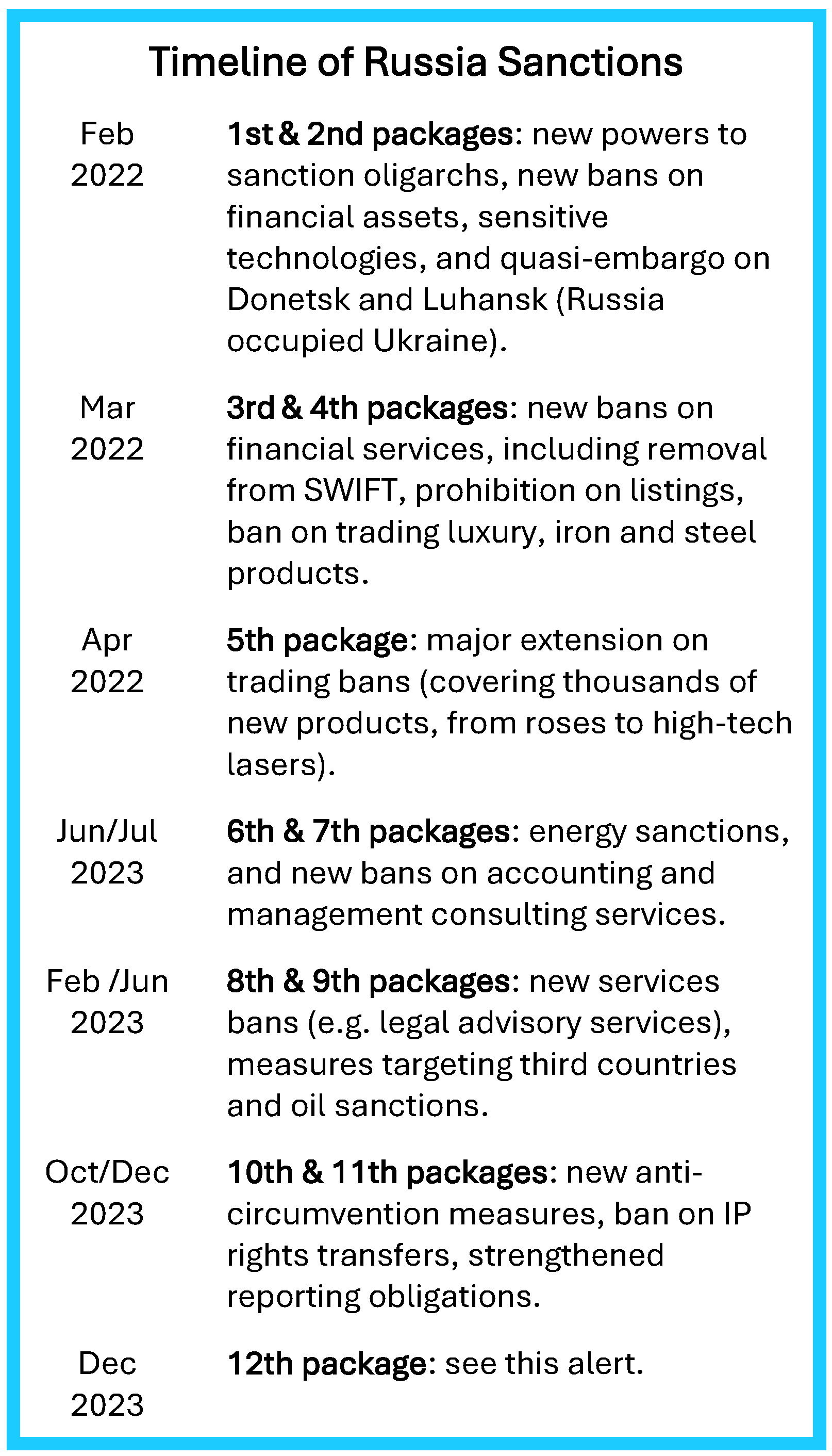
On 18 December 2023, the European Union (“EU”) issued its twelfth sanction package against Russia, which further closes the gap on permissible trade with Russia. Whilst the 10th and 11th sanction packages (issued in February 2023 and June 2023, respectively) aimed at closing down loopholes and increasing potential for enforcement, the twelfth package goes a step further by greatly increasing the scope of the regime.
Specifically, the twelfth package contains three new and unprecedented measures alongside the extension of existing trade and transactional bans. Whilst the EU labelled these as mere “technical amendments,”[1] their impact is far greater than some of the “headline”-material new trade measures (e.g. on banning diamond trade). Corporates with ongoing Russian nexus may need to completely re-assess their compliance in light of these new and extended measures.
- Overhauled ban on certain intragroup services provided to Russian subsidiaries including (i) accounting, (ii) business management consulting, (iii) legal advisory, and (iv) IT consultancy.
- New obligations on non-Russian trade activities pertaining to, inter alia, the aerospace and iron/steel industries.
- New measures to punish buyers of previously EU-owned Russian targets which were compulsorily transferred as a result of an action by the Russian government.
- Extension of trade prohibitions, covering an additional EUR 6.3 billion of trade (or about 4% of EU/Russia exports, based on FY22 figures[2]).
A. Not just a “technical amendment”: a near total ban on certain intragroup services
From 20 June 2024, the twelfth package completely overhauls the existing service prohibition (see previous alert here) to prohibit certain intragroup services provided by an EU entity (or from another friendly western nation)[3] to Russian subsidiaries unless a licence is obtained.[4]
Although there is a six-month transition period, the impact of this overhauled ban cannot be understated:
- There is a potential disruption to key corporate functions such as legal, finance and IT, as those will no longer be allowed to be provided intragroup to Russian subsidiaries, unless a licence is obtained. The overhauled ban also adds “ancillary prohibitions” on providing (i) technical assistance, (ii) brokering services, and (iii) financial assistance with regards to the prohibited services.[5] The broad definitions[6] of these “ancillary prohibitions” have a two-fold effect: (i) halfway compliance efforts are unlikely to be effective (compliance requires a total cessation of all prohibited services), and (ii) corporates will need to seek a derogation for both the main services (e.g. legal, finance, IT) as well as the ancillary ones (e.g. on technical assistance or financing).
- The new derogation mechanism is entirely discretionary. Corporates which were previously providing intragroup services to their Russian subsidiary under the automatic exemption route will now face significant legal uncertainty. Needless to say, some corporates may reach a view that decentralising these functions outweighs the benefits of maintaining their Russian operations and, thus, this “technical amendment” could become one of the greatest hurdles to keeping a Russian presence.
- The overhauled ban is a complete shift away from an exemption-based regime (where corporates used to assess their conduct by self-applying automatic exemptions set out in the law) to a discretionary derogation-based regime (where authorities have the discretion to grant licence on a case-by-case basis). With this shift, the EU’s regime now aligns more closely with the UK’s regime (which has always been largely derogations-based). However, the key distinction is that, unlike in the UK where one has two centralised licensing authorities (OFSI & ECJU), the EU’s licensing will have to be pursued through multiple member state authorities—leading to potentially uneven application/derogations across the EU (and significant inconsistencies).
B. New obligations on non-Russian trade activities
The twelfth package introduced unprecedented measures on non-Russian trade which will have an impact on prima facie non-sanctioned trade outside of the EU:
- Mandatory “No Russia re-export” contractual term for the aerospace sector. All exporters of aerospace goods (i.e. those listed in Annexes XI, XX, XXXV and XL) will be required to include a contractual obligation prohibiting the re-export of their products to Russia.[7] It is unclear who exactly is subject to this obligation, as the law merely says “exporters.” However, on a conservative reading, the rule could potentially require all exporters subject to EU sanctions[8] trading in sanctioned aerospace goods to amend all their existing contracts with third country importers, unless these importers are from friendly western nations (United States, United Kingdom, Norway, Switzerland, Canada, Australia, NZ, South Korea or Japan). The new obligation is subject to a transition period until 20 Dec 2024 (or the expiry of the contract, whichever is earlier).
- Mandatory reporting obligation on import of non-Russian iron/steel products to evidence these products were processed with prohibited Russian iron/steel. With this new obligation the EU seeks to strengthen its existing ban on the import of certain processed iron and steel products (discussed in our previous alert) unless such imports are from a “permitted” third country. At present, the “permitted” third countries are only Switzerland and Norway. In practice this means that certain steel/iron imports from, for example, the United States will now require the EU importers to prove the origin of the iron/steel prior to its processing in the United States.
C. Potential poison pill: new designation criterion for compulsory transfer of previously EU-owned Russian assets
The twelfth package introduces a new designation criterion allowing the Commission to freeze the assets of previously EU-owned Russian targets which were compulsorily transferred following an action by the Russian government. This new designation mechanism also includes the possibility to freeze the assets of the buyers of those Russian targets, as well as any board members of the transferred Russian target.
This measure is in response to the existing Russian counter-sanctions enabling the Russian government to take over western-owned companies (e.g., in 2023, Russia took control of the local assets of several large EU groups).[9] By targeting also managers and buyers of the forcibly acquired business, the EU is hoping to deter private buyers from acquiring western-owned businesses in a dubious manner.
That said, as at the time of writing, this new criterion has not yet been used and therefore the extent of its impact remains unclear. In any event, consensual sales will not be impacted (as the criterion would then not apply).
D. Extended trade measures
Import ban
The twelfth package adds new goods to the existing import ban; in particular, it adds: liquified hydrocarbons, iron, copper, and aluminium products.[10] These new import prohibitions benefit from a general wind-down period until 21 March 2024 (with some specific items benefiting from a longer wind-down until 29 Dec 2024).
The EU also introduced an import ban on diamonds products (listed in a new Annex XXXVIIIA)[11] with two key features: (i) it applies to all exports from Russia to any third country (not just the EU), as well as all exports of any third country if they transited through Russia,[12] and (ii) it only benefited from a very short wind-down period (until 1 January 2024). The diamond ban also reproduces the existing prohibition on iron and steel imports from third countries by prohibiting certain non-Russian imports of diamonds if these products are processed from prohibited Russian imports. Unlike the iron and steel prohibition, however, there is no “friendly country” exemption.
Export ban
The twelfth package adds new goods and services to the existing export ban which will require additional compliance efforts for corporates still trading with Russia. In particular:
- Additional goods were added to the existing export lists.[13] For example, all iron and steel products (under Combined nomenclature (CN) code 72) are now prohibited from exports (as opposed to specific iron and steel products beforehand). These additions do not benefit from any wind-down or transition period. Separately, new goods lists[14] were added to the existing export ban,[15] with a wind-down period until 20 March 2024 (for Annex XXIIIA) and 20 June 2024 (for Annex XXIIIB).
- A new Annex XXXIX was also added specifically to ban the export of enterprise and design-related software.[16] That ban appears to be intended as a flanking measure to the existing ban on providing IT consultancy services (discussed in our previous alert). The wind-down period for the new software export ban is until 20 March 2024, and there is a separate transition period until 20 June 2024 for Russian subsidiaries (following which a licence can be applied for, as with intragroup services discussed above).
Conclusion
The twelfth package is a large expansion of the scope of the EU’s sanctions against Russia. Through both (1) an overhaul of the ban on certain intragroup services provided to Russian subsidiaries (including (i) accounting, (ii) business management consulting, (iii) legal advisory, and (iv) IT consultancy), and (2) an extension of existing measures on trade, the EU is clearly looking to deter all trade with Russia—stopping short of an outright embargo.
These changes are not mere posturing but will have actual impact on both EU and ex-EU trade with Russia. For example, key corporate functions for Russian subsidiaries of EU, US and UK operators will be disrupted due to the new default ban on intragroup services. Similarly, the use of wider CN codes means that corporates will need to re-assess whether their trade with certain goods is still permitted.
Equally, the new reporting requirements suggest an increasing frustration of EU authorities with circumvention. Certain EU operators will now be required to report on activities (or amend contracts) involving a clearly non-Russian trade simply to prove that there was no Russian nexus elsewhere in the value chain.
[1] See Recital 24 of Regulation 2023/2878.
[3] See Annex VIII of Regulation 833/2014 as amended, as at time of writing it includes the United States, United Kingdom, Norway, Switzerland, Australia, New Zealand, Canada, Japan, and South Korea.
[4] See Articles 5n(7) and 5n(10)(h) of Regulation 833/2014, as introduced by Regulation 2023/2878.
[5] See Articles 5n(3a) of Regulation 833/2014, as introduced by Regulation 2023/2878.
[6] Definitions for these can be found in Article 1(c), 1(d) and 1(o) of Regulation 833/2014, as well as the EU’s FAQs (pages 136, 182 and 183).
[7] See Article 12g introduced by Regulation 2023/2878.
[8] This includes EU nationals, EU residents, EU entities, and non-EU entities conducting business in the EU.
[9] See Reuters “Putin signs law on barring 'unfriendly' foreigners from owning stakes in Russian firms” dated 4 August 2023. These measures were recently extended to 2024; see Yahoo News “Putin signs law that limits rights of foreign ownership of firms in Russia” dated 26 December 2023.
[10] See Article 3i and Annex XXI as amended by Regulation 2023/2878.
[11] See Annex XXXVIIIA introduced by Regulation 2023/2878.
[12] See Article 3p(1) to (4) introduced by Regulation 2023/2878.
[13] Both Annex VII and Annex XXIII include additional chemicals, lithium batteries, rubbers, and various motors, engines and industrial tools and machinery parts.
[14] See new Annex XXIIIA which includes various chemicals, plastics, base metals, industrial tools and machinery, batteries, and optoelectronics, and Annex XXIIIB which includes additional plastics, base metals and parts made thereof, and machines.
[15] See Article 3k, para 3aa and 3ab introduced by Regulation 2023/2878.
[16] See Article 5n, para 2b introduced by Regulation 2023/2878.
This communication is for general information only. It is not intended, nor should it be relied upon, as legal advice. In some jurisdictions, this may be considered attorney advertising. Please refer to the firm’s data policy page for further information.