Advocating for Veterans on the Path to Benefits
For veterans seeking disability benefits from the Department of Veterans Affairs (VA), the path is often long and complex. When claims are denied or critical evidence is overlooked, veterans may turn to the courts for another chance to have their cases heard — a process that can stretch on for years, even decades.
We have a longstanding commitment to representing veterans and their families in appeals before the US Court of Appeals for Veterans Claims (CAVC), the US Court of Appeals for the Federal Circuit and, when necessary, on remand to the Board of Veterans’ Appeals. Over the past year, in partnership with The Veterans Consortium Pro Bono Program, a national nonprofit providing free legal services in federal fora for veterans in need, our lawyers have advocated for veterans in several appeals, helping secure favorable results and advancing cases toward the benefits their clients have sought for years.
The timescales involved can be staggering. One of our clients has been fighting for recognition of a service-related traumatic brain injury for more than 40 years. Another has seen his post-traumatic stress disorder (PTSD) claim caught in a bureaucratic contradiction for nearly 20 years. These cases demand patience, rigor and persistence — and they are exactly the kind of work our attorneys are eager to take on.
Reexamining a 40-year-old traumatic brain injury claim
The client, “Mr. B,” is a US Army veteran who served for more than 10 years. During his service, he was involved in a serious accident in which his vehicle rolled over twice, causing him to lose consciousness. He later began experiencing symptoms consistent with traumatic brain injury (TBI) — headaches, memory problems, difficulty concentrating and trouble sleeping. Despite his history of service and symptoms, the VA declined to find that his TBI was connected to his active-duty service.
We received Mr. B’s case as a referral from The Veterans Consortium in the fall of 2025, with a team including partner Candice C. Wong and associate Valeria Komarov. They began by reviewing the Record Before the Agency — a collection of medical records spanning more than 40 years.
The sheer volume presented an initial challenge, but as the team worked through the records, they found evidence that supported the client’s claim and raised important questions about how the VA had evaluated his condition.
The VA’s review had focused largely on the physical manifestations of the veteran’s condition. The team took a broader view, identifying evidence of cognitive and emotional symptoms associated with TBI that had not been adequately addressed. In a Statement of Issues filed with the Veterans Court, the team argued that the Board had improperly denied service connection by failing to account for the VA’s duty to assist the veteran in developing his claim. As part of their argument, the team pointed to a flawed record containing contradictory medical findings and the VA’s failure to address a medical examiner’s conclusion that distinguishing between TBI and mental health symptoms was “impossible.”
The Secretary of Veterans Affairs ultimately conceded certain errors. In May 2026, the Court granted the parties’ joint motion for partial remand, sending the case back to the Board for reconsideration — and giving Mr. B. a renewed hope that a service-connected injury affecting his daily life for more than 40 years would finally be recognized.
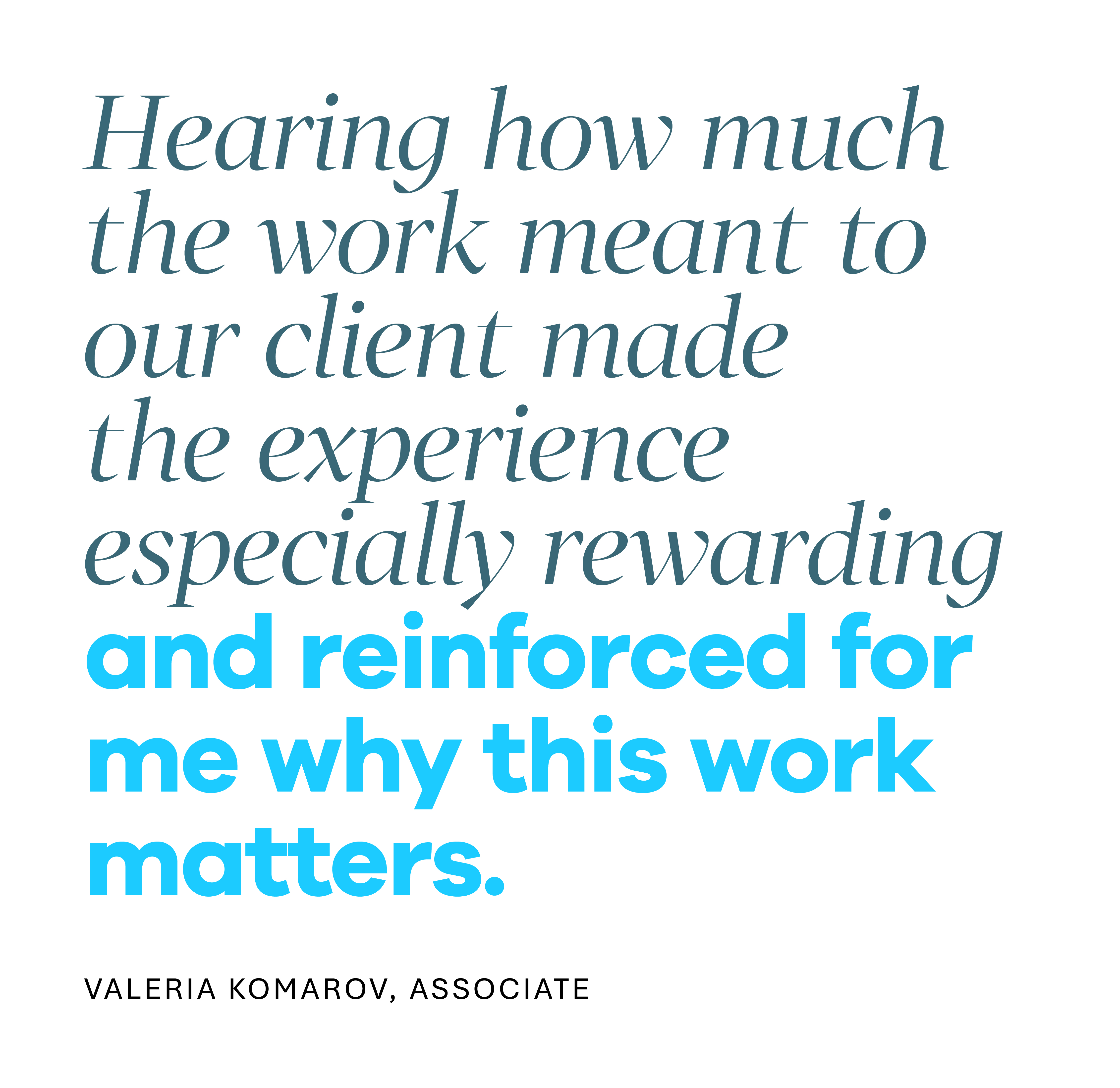
For Valeria, the matter offered a valuable opportunity to see the impact of pro bono advocacy firsthand. “Working on this case enabled me to learn not only about the legal issues involved, but also about the medical complexities surrounding veterans’ disability claims,” she said. “Most importantly, hearing how much the work meant to our client made the experience especially rewarding and reinforced for me why this work matters.”
A tale of two letters
In another matter, partner Candice C. Wong and associate Jonathan A. Picado are representing a veteran whose claim for PTSD benefits has been entangled in a bureaucratic contradiction for nearly 20 years. 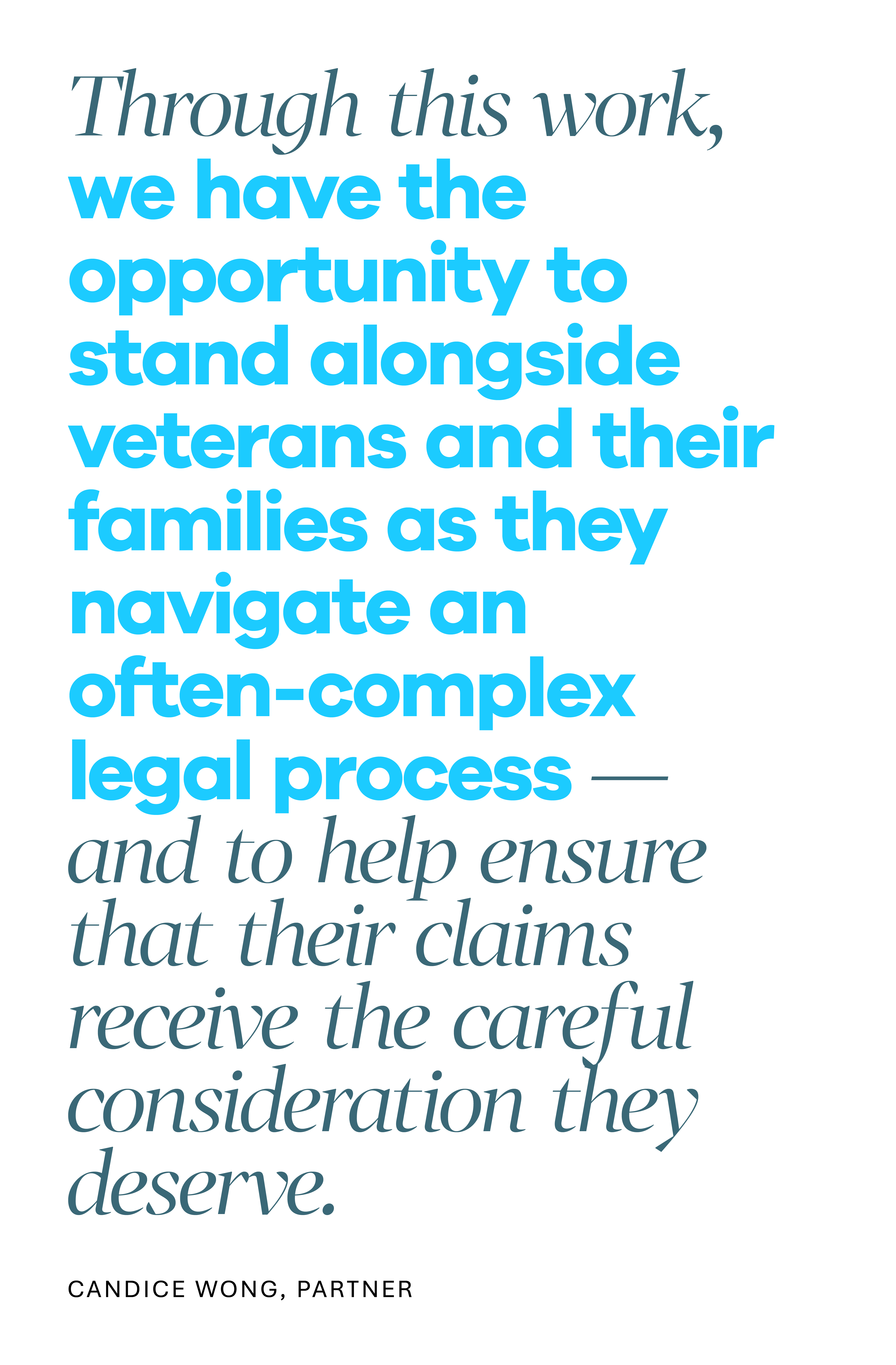
The client, “Mr. T,” served in the US Army and filed his claim nearly two decades ago. On the same day, the VA sent him two seemingly contradictory letters: one amending his claim and another denying it. The VA never explained how the two letters should be reconciled or whether one superseded the other.
"As you can imagine, this was extremely confusing for our client, who had already served his country and was now trying to navigate a complex process," Jonathan said. "He was left searching for answers for nearly two decades and largely led his own fight until he secured pro bono counsel through The Veterans Consortium Pro Bono Program."
Years later, the VA ultimately granted Mr. T benefits, but not retroactive to the date of his original application.
The central question became whether his original claim had ever actually been decided. Our appeal to the Federal Circuit challenges the CAVC’s attempt to resolve the contradiction between the two letters for the first time, arguing that doing so exceeded the court’s jurisdictional limits on fact finding. The appeal also challenges the VA’s post-hoc explanations for the conflicting letters, which the CAVC ultimately accepted, arguing that those explanations run afoul of the administrative law principle known as the Chenery doctrine. Alternatively, Mr. T’s brief contends that to the extent the VA is viewed as having implicitly denied Mr. T’s original claim, the Constitution would have required an implicit-denial analysis that was absent.
With the briefing now submitted, Mr. T’s case moves forward in his effort to obtain the retroactive benefits he believes he should have received nearly 20 years ago.
A commitment to veterans
We currently have several ongoing matters representing disabled veterans in appeals of VA disability benefit decisions, led by associates including Wellington Baumann and Elizabeth J. Kalanchoe. The pipeline continues to grow and so does the expertise our lawyers bring to it.
“It is a privilege to represent veterans who have sacrificed so much in service,” said Candice, who has helped lead the firm’s pro bono veterans benefits work since joining Fried Frank in 2025. “Through this work, we have the opportunity to stand alongside veterans and their families as they navigate an often complex legal process — and to help ensure that their claims receive the careful consideration they deserve.”
-

Candice C. Wong
Partner
-

Valeria Komarov
Associate
-

Jonathan A. Picado
Associate
-

Wellington Baumann
Associate
-

Elizabeth J. Kalanchoe
Associate